
The following table shows a completed Advancement Rule Table for a small regional tournament. Because this region never advances more than three teams in a challenge level and because they don’t have any teams competing in the University Level, we’ve eliminated the corresponding rows from the table.
| Age or Grade Level | # Teams Advancing | # Teams Competing (range) | Team Count Boundary |
|---|---|---|---|
| Elementary | 1 | 1-7 | 1 |
| 2 | 8-14 | 8 | |
| 3 | 15 + | 15 | |
| Middle | 1 | 1-10 | 1 |
| 2 | 11-20 | 11 | |
| 3 | 21 + | 21 | |
| Secondary | 1 | 1-5 | 1 |
| 2 | 6-10 | 6 | |
| 3 | 11 + | 11 | |
For each level, note that whenever the # Teams Advancing is 1, then the Team Count Boundary is always 1. This means that if there is at least one team participating in a challenge at that level, then they will advance one team to the next level of competition.
At the Elementary level, there must be eight (8) teams competing in a challenge level in order for the region to advance two teams, and 15 teams competing in order for them to advance 3 teams. For example, if there are 6 teams in an elementary challenge, then 1 team advances, but if there are 12 teams, then 2 teams advance.
At the Middle level, where they typically have the most teams, this region advances 1 team unless they have more than 10 teams competing in a middle level challenge. If they have at least 11 teams, then they advance two teams, and if 21 or more teams compete in a challenge level, then they’ll advance three teams.
At the Secondary level, where they have the fewest teams, the region advances 1 team for every 5 teams competing. For example, if 7 teams compete in a secondary challenge, the region advances 2 teams.
Requesting this through the Tournament Wizard
Compare this to the Tournament Wizard’s expression of the Advancement Rules in the image below.
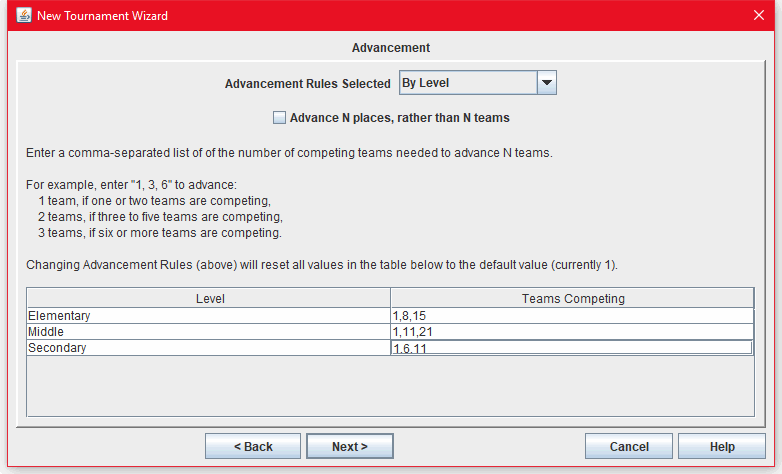
You’ll see that:
- The Elementary Level “Team Count Boundary” from the table above – 1,8,15 – appears on the Elementary line of the image below Teams Competing.
- The Middle Level “Team Count Boundary” from the table above – 1,11,21 – appears on the Middle line of the image.
- The Secondary Level “Team Count Boundary” from the table above – 1,6,11 – appears on the Secondary line of the image.
But your Tournament will be Different from this Example!
Here are some generalizations that we can suggest – one of these might apply to your Tournament.
- You may need to advance a certain maximum number of teams from a Level at your Regional Tournament to your Affiliate Finals – advance 1 if you have only one, advance 2 if you have only two, …, up to advance 4 if you have four or more. That’s going to look like 1,2,3,4.
- The first example above may also be thought of as “you can advance your top 4 teams,” either from Regional to Affiliate Finals OR from Affiliate to Global Finals. Again, that’s 1,2,3,4!
- You’re in a small Affiliate – you can advance only one team from each Challenge and Level to Globals. That’s just expressed by 1.
We hope this has lifted some of the “fog” to allow you to use the fewest typed characters to explain to the “stupid computer” what you need it to understand – all to get the G‘s in the right places – and that means that Team’s “Goin’ on!“